Safeguarding Global Assets: How High-Earning NRIs Can Manage the 120-Day Stay Limit
 |
| Expert planning for the global citizen |
For global Indian entrepreneurs and high-net-worth expats, visiting home was once an effortless routine. As long as your stay remained below the traditional 182-day mark, your international business assets and offshore income streams were entirely insulated from the Income Tax Department.
Recent regulatory updates have fundamentally altered that dynamic.
Domestic authorities have substantially tightened cross-border compliance. Driven by the reduced 120-day physical presence threshold alongside stricter Section 6(1A) deemed residency clauses, managing your presence in India now demands strategic foresight. Off-by-one errors on your itinerary can inadvertently trigger compliance obligations across your international portfolio.
Here is a clear breakdown of how these framework updates operate in 2026.
The Core Framework: Decoding NR, RNOR, and ROR
Your citizenship isn’t what determines your tax bill in India — your residential status does. Section 6 of the Income Tax Act breaks every individual down into three distinct brackets:
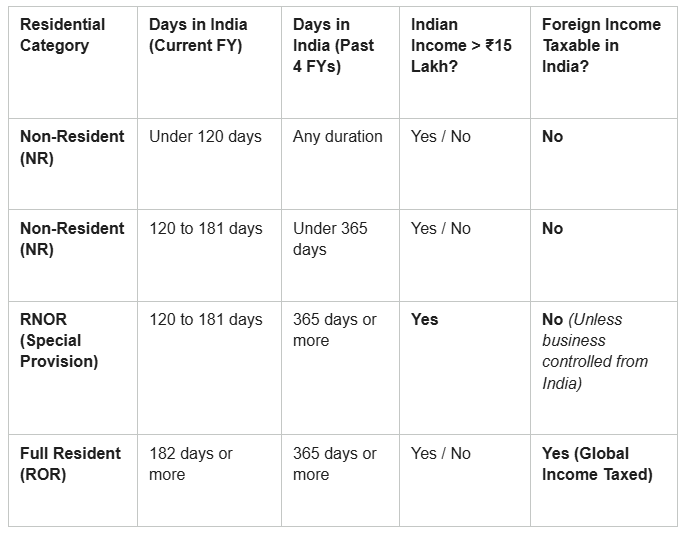
- Non-Resident (NR): The gold standard for expats. You only pay Indian tax on money earned or received inside India. Foreign assets? Untouched.
- Resident but Not Ordinarily Resident (RNOR): A hybrid category. You are technically a resident, but your foreign income stays exempt — unless it’s tied to a business directly controlled from within India.
- Resident and Ordinarily Resident (ROR): The red zone. Your worldwide income becomes subject to Indian taxes, and every offshore account must be declared in your tax return.
Where High-Earning NRIs Get Caught
The rules change dramatically the moment your taxable income generated inside India (excluding offshore earnings) crosses the ₹15 lakh mark in a single financial year.
If you hit that threshold, the traditional 182-day grace period disappears. Spend 120 days or more in India during the current year — and a cumulative 365 days across the previous four years — and your pure Non-Resident (NR) shield breaks. You instantly drop into the RNOR bucket.
The Gulf & Tax-Haven Trap: Section 6(1A) “Deemed Residency”
Do you reside in Dubai, Singapore, or Monaco? Pay close attention.
Under Section 6(1A), if you hold Indian citizenship, earn over ₹15 lakh from Indian sources, and live in a zero-tax jurisdiction where you aren’t personally “liable to tax,” India automatically labels you a deemed resident.
The Catch with Deemed Residency
You become an RNOR even if you set foot in India for zero days during the entire year.
While RNOR status generally protects your foreign salary and passive bank interest, it leaves a dangerous side door open. If the tax department argues that your offshore holding company or consultancy is “managed or controlled” from India during your personal visits, those foreign earnings suddenly face domestic tax scrutiny.
Actionable Steps to Protect Your Non-Resident Status
Don’t let sloppy scheduling jeopardize your wealth. Here is how seasoned global investors protect their tax footprint:
1. Count Your Days Like Clockwork
Keep exact track of passport stamps. In the eyes of the tax department, both your flight arrival date and departure date count as full days spent in India. Keeping your stay at 119 days or fewer keeps your pure NR status rock-solid, no matter what your domestic income looks like.
2. Lock Down a Tax Residency Certificate (TRC)
Living in a low-tax or zero-tax region? Get your official Tax Residency Certificate (TRC) immediately from local authorities. A valid TRC acts as concrete proof of foreign residency when claiming benefits under Double Taxation Avoidance Agreements (DTAA).
3. Draw a Hard Line Between Business and Travel
Never sign corporate documents, conduct strategic board meetings, or issue executive orders for foreign entities while vacationing in India. Tax officials look closely at the “Place of Effective Management” (POEM). Keep overseas business operations strictly offshore.
Expert Insights:
Q1: What is the 120-day rule for NRIs in India?
It is a tax residency trigger for Indian citizens or Persons of Indian Origin (PIOs) earning over ₹15 lakh from domestic Indian sources. If they stay in India for 120 to 181 days in a financial year — and logged 365+ days in India across the previous four years — their status automatically converts from Non-Resident (NR) to RNOR.
Q2: Does falling under RNOR status mean my foreign salary gets taxed in India?
No, it doesn’t. RNOR status continues to insulate your foreign salary, foreign property income, and offshore investments. India will only tax income that originates within its borders or income from a foreign business that is directly managed or controlled from inside India.
Q3: What counts toward the ₹15 lakh income limit?
Only income sourced inside India counts. This includes rental returns from local properties, Indian stock dividends, capital gains on domestic assets, and interest from NRO accounts. Your foreign earnings, salary paid abroad, and overseas investment returns are completely excluded from this math.
Q4: Do flight arrival and departure days count as full days spent in India?
Yes, absolutely. Tax authorities count both the date you land and the date your flight leaves as full 24-hour periods spent in the country. Always factor these entry/exit dates into your 119-day safety budget.
Q5: What happens if an NRI crosses the 182-day mark in India?
Once you hit 182 days in a single financial year, you lose all expat concessions and become a Resident and Ordinarily Resident (ROR). This forces you to pay Indian income tax on your worldwide income and disclose every foreign asset and bank account in your annual tax return.
Q6: Can a Dubai-based NRI get tagged as an Indian tax resident without visiting India?
Yes. Thanks to the “Deemed Residency” clause in Section 6(1A), an Indian citizen earning more than ₹15 lakh from Indian sources who lives in a country with no personal income tax can be classified as a deemed resident (RNOR), even with zero days of physical stay in India.
Q7: What is the main practical difference between an NR and an RNOR status?
While both shield foreign earnings from Indian taxes, a pure NR enjoys specific perks that an RNOR might lose out on. This includes lower Tax Deducted at Source (TDS) rates on certain investments and specialized banking/investment privileges under Chapter XII-A of the Income Tax Act.
Final Takeaway
Protecting your global wealth isn’t something you do in March right before the financial year closes. It requires year-round discipline. By tracking your travel dates, keeping corporate management overseas, and structuring your Indian asset income smartly, you can enjoy your time back home without taking on an unnecessary tax bill.
For details, please call on — +91 98186 66165
Or, visit us at — https://rsav.co.in/resource/home.aspx
Address: Second Floor, Champa Gali, 317/276, Lane Number 3, Saidulajab, Saket, New Delhi, Delhi 110030.
Location — https://maps.app.goo.gl/s1qMAqFWa8m3sNK68
.png)
.png)
Comments
Post a Comment